content type paperpublished April 2025
EC-DIT: Scaling Diffusion Transformers with Adaptive Expert-Choice Routing
AuthorsHaotian Sun†‡, Tao Lei, Bowen Zhang, Yanghao Li, Haoshuo Huang, Ruoming Pang, Bo Dai‡, Nan Du
EC-DIT: Scaling Diffusion Transformers with Adaptive Expert-Choice Routing
AuthorsHaotian Sun†‡, Tao Lei, Bowen Zhang, Yanghao Li, Haoshuo Huang, Ruoming Pang, Bo Dai‡, Nan Du
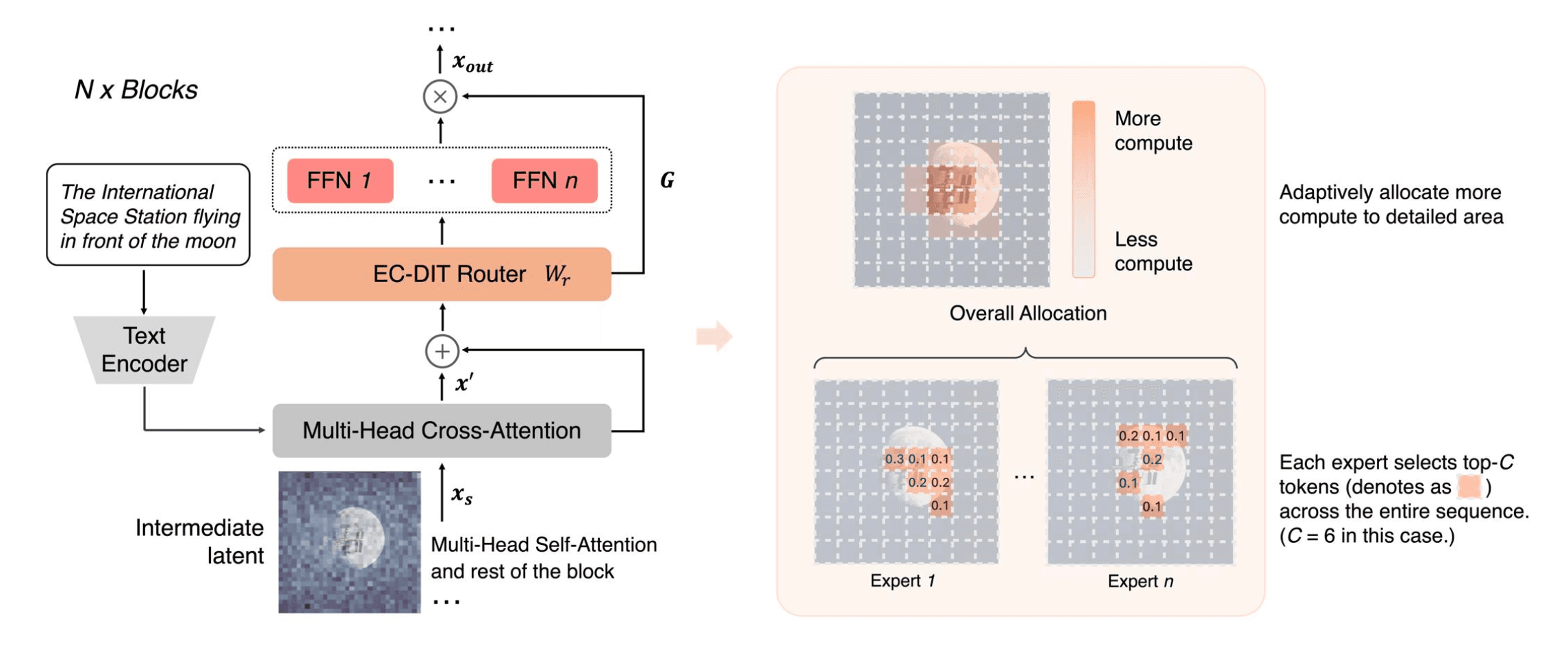
Diffusion transformers have been widely adopted for text-to-image synthesis. While scaling these models up to billions of parameters shows promise, the effectiveness of scaling beyond current sizes remains underexplored and challenging. By explicitly exploiting the computational heterogeneity of image generations, we develop a new family of Mixture-of-Experts (MoE) models (EC-DIT) for diffusion transformers with expert-choice routing. EC-DIT learns to adaptively optimize the compute allocated to understand the input texts and generate the respective image patches, enabling heterogeneous computation aligned with varying text-image complexities. This heterogeneity provides an efficient way of scaling EC-DIT up to 97 billion parameters and achieving significant improvements in training convergence, text-to-image alignment, and overall generation quality over dense models and conventional MoE models. Through extensive ablations, we show that EC-DIT demonstrates superior scalability and adaptive compute allocation by recognizing varying textual importance through end-to-end training. Notably, in text-to-image alignment evaluation, our largest models achieve a state-of-the-art GenEval score of 71.68% and still maintain competitive inference speed with intuitive interpretability.
†Work done during an Apple internship.
‡Georgia Institute of Technology
DiT-Air: Revisiting the Efficiency of Diffusion Model Architecture Design in Text to Image Generation
December 11, 2025research area Computer Vision
In this work, we empirically study Diffusion Transformers (DiTs) for text-to-image generation, focusing on architectural choices, text-conditioning strategies, and training protocols. We evaluate a range of DiT-based architectures—including PixArt-style and MMDiT variants—and compare them with a standard DiT variant which directly processes concatenated text and noise inputs. Surprisingly, our findings reveal that the performance of standard…
On Inductive Biases That Enable Generalization of Diffusion Transformers
September 22, 2025research area Computer Visionconference NeurIPS
Recent work studying the generalization of diffusion models with UNet-based denoisers reveals inductive biases that can be expressed via geometry-adaptive harmonic bases. However, in practice, more recent denoising networks are often based on transformers, e.g., the diffusion transformer (DiT). This raises the question: do transformer-based denoising networks exhibit inductive biases that can also be expressed via geometry-adaptive harmonic…

Our research in machine learning breaks new ground every day.